What Are Rice Husk Pellets? Technical Standards for Export
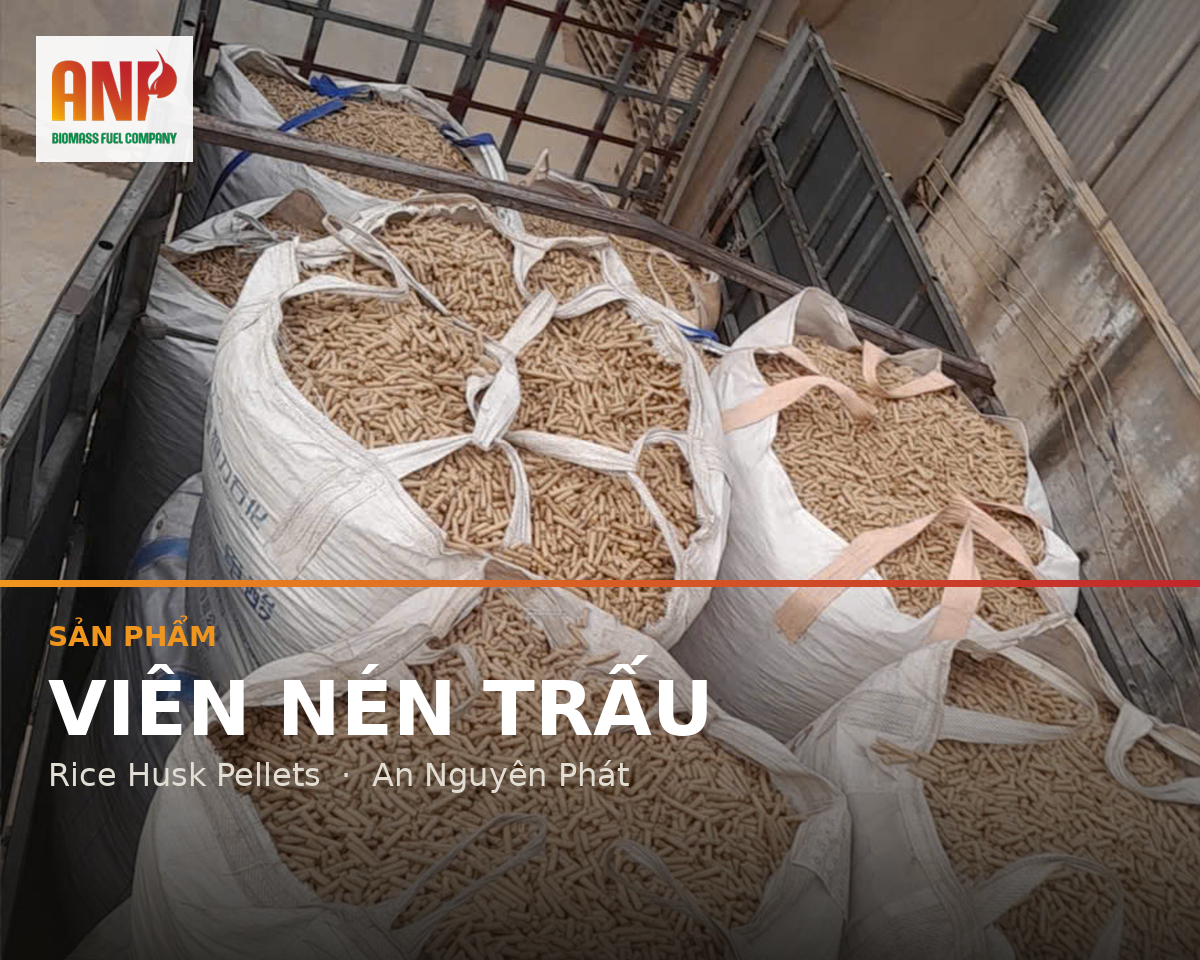
Rice husk pellets are a biomass fuel compressed from 100% rice husk — a by-product of the rice milling process — used to replace coal or firewood in industrial boilers. The product delivers a calorific value above 3,800 kcal/kg and meets the emission standards required for export and for supply to foreign direct investment (FDI) factories.
How Are Rice Husk Pellets Produced?
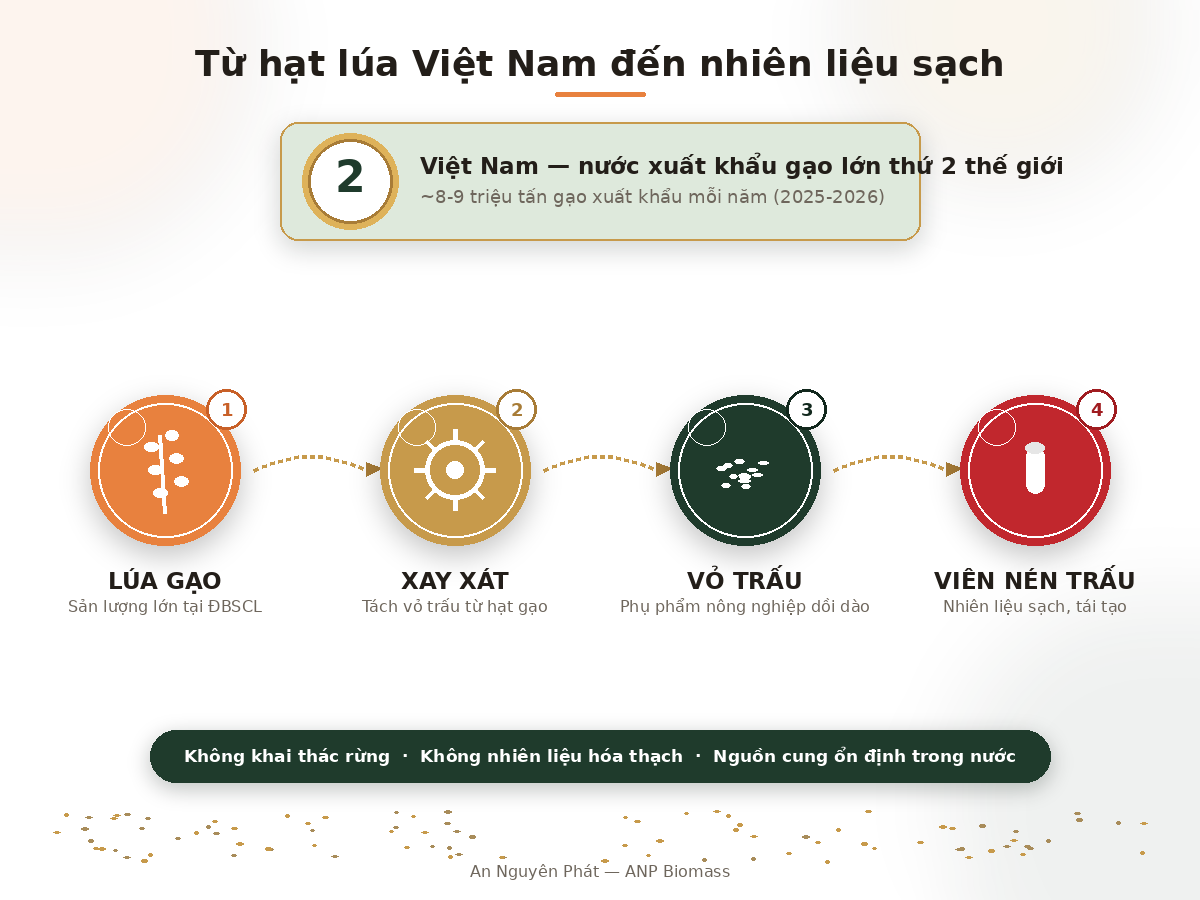
After being separated during the rice milling process, rice husk is ground, dried to reduce moisture, and then compressed under high pressure and temperature into cylindrical pellets without any chemical binder — the natural binder is lignin already present in the husk. This process gives rice husk pellets high density, stable combustion, and easier storage and transport compared to loose husk.
Why Does Vietnam Have an Abundant Supply of Rice Husk Raw Material?Vietnam is currently the world’s second-largest rice exporter after India, with export volumes maintained at 8–9 million tons per year. High rice output also means an abundant supply of rice husk — an inevitable by-product of milling — concentrated mainly in the Mekong Delta. https://vietfood.org.vn/xuat-khau-gao-nua-dau-nam-2026-giu-nhip-tang-truong/
This gives rice husk pellets produced in Vietnam a stable raw material advantage. In addition, because it is produced from an agricultural by-product rather than harvested wood or fossil fuel, rice husk pellet fuel is considered clean and renewable, placing no additional pressure on forest resources — aligning with the green energy transition that many FDI factories are pursuing.
| Parameter | Specification |
| Composition | 100% rice husk |
| Calorific Value (ARB) | 3.800 kcal/kg |
| Ash Content | 18% |
| Độ ẩm | <10% |
| Diameter | 12mm / 8mm |
| Length | 10–40mm |
| Sulfur (%S) | 0.5% |
| Nitơ (%N) | 1% |
| Clo (%Cl) | 1% |
| Packaging | Jumbo bag 700–800kg/bag, hoặc đổ xá |
Do Rice Husk Pellets Meet Export Standards?
Yes. With low sulfur and nitrogen content, rice husk pellets meet the common emission standards required by factories in Europe and Japan for industrial combustion fuel. This is also why an increasing number of FDI factories in Vietnam are choosing rice husk pellets to replace coal, particularly in the textile dyeing and sportswear industries, where major brands such as Nike, Adidas, and Decathlon are tightening supply-chain emission-reduction requirements.
Note: each import market (EU, Japan, South Korea, etc.) may have its own regulatory thresholds that change over time. Factories should verify the actual COA against the specific requirements of their partner or the regulatory authority in the import market before signing a long-term contract.
Why Are Rice Husk Pellets Suitable for FDI Factories?
Frequently Asked Questions
What are rice husk pellets?
A biomass fuel compressed from 100% rice husk, used to replace coal or firewood in industrial boilers.
What is the calorific value of rice husk pellets?
Above 3,800 kcal/kg (ARB), with ash content below 18% and moisture below 10%.
Why does Vietnam have an abundant supply of rice husk pellets?
Because Vietnam is the world’s second-largest rice exporter — high rice output means an abundant husk supply, concentrated mainly in the Mekong Delta.
Do rice husk pellets meet export standards for Europe and Japan?
Yes, with low sulfur and nitrogen content, meeting the emission requirements of many international markets. Customers should request a COA to verify compliance with the specific standards of their import market.
How can I get a quote and a sample of rice husk pellets?
Contact An Nguyen Phat at 0973 116 191 or Email: annguyenphatbiomass@gmail.com.
Get a Quote and Sample of Rice Husk Pellets